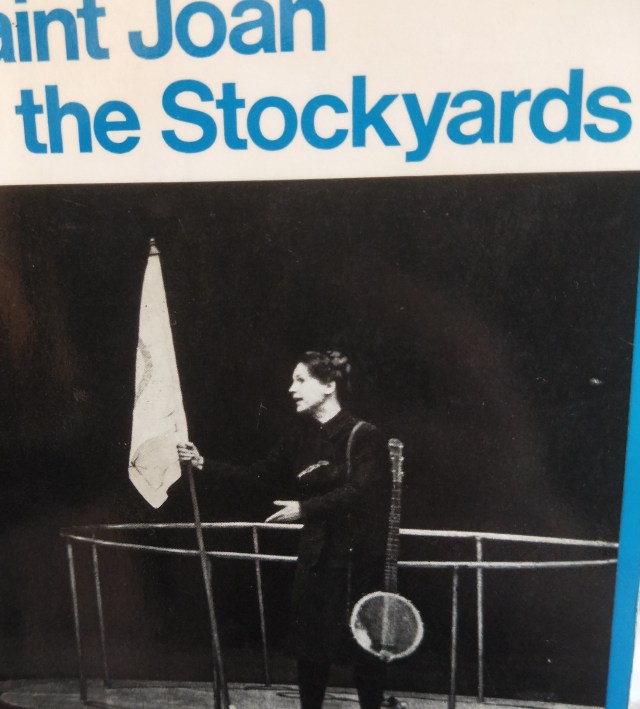
What I’m Reading Now – Saint Joan of the Stockyards, by Bertolt Brecht

Time to write about a play. If only to confirm that I do read them and that I do, in fact, like theatre as well as books.

So, first off, I love Brecht insofar as any political or socially engaged theatre maker is indebted to him. He’s the Nicki Minaj of Weimar-era shit talking and he’s the innovator that allowed twentieth century Western audiences to think of theatre as a tool for radical social change.

I can’t remember who said it, or where I read it, but there’s a quote bobbling around in my head that says ‘No one has ever written a play‘*.  People have written scripts, which are not, in and of themselves, anything like a play. They are key ingredients of what is an act that can only happen in real-time.  It has to be live, to be living, and then under such conditions (an audience watching a live performance) a script and a design and a score and an actor’s choices combine to become the artistic, civic and political thing we call ‘a play’.

What I’m saying, I suppose, is that Brecht’s plays are a glory to experience, but his scripts are not so glorious and I find they can be awfully hard to read.

Now that I think about it, I often hear praise of his theatrical style, his social commentary, his general innovation and comic genius, without hearing much praise for his writing. His work is in translation from German, so maybe the good stuff is getting lost.  But I’m still never excited about reading Brecht, which I had to do a lot of in college. I’m just excited about seeing his ideas happen.  Perhaps this is a more universal thing than I thought previously.

Saint Joan of the Stockyards is a play that critiques capitalism. Politics, and politics only, is its reason for being.  Kurt Weill, the composer whose music defined Brecht’s great plays, abandoned their fruitful collaboration at some point*, if I recall correctly, because he was not content simply ‘to set communism to music‘*.  So before you read/see Saint Joan of the Stockyards, know that a lot of socialism and a lot of meat is about to be served.

And, boy oh boi oh bae, is this play full of meat.  It critiques capitalism by making the horrors and mechanics of capitalism drive the narrative. Set in a fictional Chicago stockyards, the entire plot is dictated by economic interactions between meat-packers, stock-breeders, small speculators, and workers.  You have a lot of discussion of prices of steers and hogs, and if you lose the economic plot, you lose the play plot – you lose who is evil and treacherous, who is a tyrant and who is a victim. So keep your eyes on the rising price of livestock.

This is a funny play, I imagine, when staged (you can tell it contains all the material and nudges towards parody and humour) though you will not laugh while reading it. It is a play that would be very powerful, if staged, and which has some stonking monologues, if staged, but it will not power-house or stonk you in text form. It is something that I feel like screaming ‘THE HOUSING CRISIS! ST JOAN OF THE MISUSED STATE ASSETS’ to.

Because Brecht is always relevant, always a Boss Ass Bish.

Always charming, and fatally righteous

And always, always, a bore to read.

Read if – you’re a theatre student, or thinking of directing it (do!)

Avoid if – you’re a vegetarian, or a neo-liberal (spoiler – Brecht doesn’t let the market sort itself out).

*I operate a ‘My Favourite Murder’ inspired policy of not really doing any research to back up the statements on my blogs, on even easily-Google-able things.

What I Just Saw – Jimmy’s Hall, Directed by Graham McClaren

Jimmys-Hall-1400x600

After being such a Deirdre Of The Sorrows about one of the Abbey’s recent offerings, I am determined to be nice about Jimmy’s Hall.

I went to see it for the cast. Actors Lisa Lambe and Ruth McGill are two of the soundest leading ladies in Irish theatre, and they joined a cast including Bosco Hogan, Donal O’Kelly and the fiddle player Aindrias De Staic. I also got offered a free ticket (thank you Fáilte Ireland). So I went. Sure, why wouldn’t you.

Let’s jump straight to the extended go if / avoid if section…

Go if – you like musicals! And/or you love Irish music in an all-embracing way (eg not just posh trad like The Gloaming)

Go if – you’re a tourist!

Avoid if – you’re a writer!

Avoid if – you don’t like musicals. Also, avoid if you find spirited American audience members clapping along at every song, as if a play is a session, when it is not a session, it is, in fact, a play, irritating or cringeworthy.

Go if – you like theatre that is tasty, lively and my, oh my, quite good looking

Avoid if – you like theatre that is high in nutritional value

Avoid if – you’re the ‘Thinking Man’ that people refer to when they say ‘It’s The Thinking Mans’ dot dot dot…

Go if – you love Lisa Lambe – her voice is a shining star of the production

Avoid if – you like your theatre naturalistic, gritty, your humour more than vaguely humorous

Go if – you want a brief reminder of the threat that fascism held across Europe, including in Ireland, during the 30’s.

Go if – You love bashing De Valera.

Avoid if – You’re me.

Go if – YOU LOVE AN AUL DANCE!

The Polyglot Project – Part One

IMG20180813220943.jpg

Ah the failed hobbies, ambitions and various follies of the fickle mind.

It would be true to say that I’ve tried my hand a many things.

Like every girl raised in South Dublin in the nineties, I spent a short spell as an aspiring dancer after seeing Save The Last Dance and another short spell as a Wiccan on account of The Craft. Not physically or spiritually limber enough for either of those, I tried sports. In my first year of secondary school, I made the A Team in the sport of ‘hockey’ (you may have heard of it last week) as a substitute, before being demoted to the B team in second year, the C team in third year, and quitting in fourth.  I turned to debating, full time, which I was actually very good at, probably because, at that time, I was also a real asshole. I then promptly gave up it in college after becoming a decent human being.

Besides being a dancer, a Wiccan, a hockey player and obnoxious, I took it upon myself to insult canvasses with paint from time to time, insult ears with a saxophone, and had an awfully embarrassing (should the footage ever emerge) Transition Year as an aspiring film maker.  Next a vegan, a club-kid, nearly a squatter, not a squatter, a performance artist, a producer, a children’s entertainer, a spoken word poet, a drinker, a smoker, and – finally – a boxer. I even started listening to a boxing podcast (5 Live Boxing with Costello and Bunce. Would recommend).  I now have Achilles Tendonitis and will not be boxing for quite a long time.

But one of the only things I’ve always done consistently, but never thought much of, is attempt to learn languages.  I use the word attempt, because it seems that the process of learning languages is my hobby, not actually using them a whole bunch.

And while all of the languages we learn, even briefly, do stay with us in many parts of our brains and bodies, language fluency needs regular upkeep and affection.  So while I collect languages quickly, I do not always feed and water them consistently.  Fluency tends to wither and fade.

A bullet-pointed history of my multi-lingual exploits –

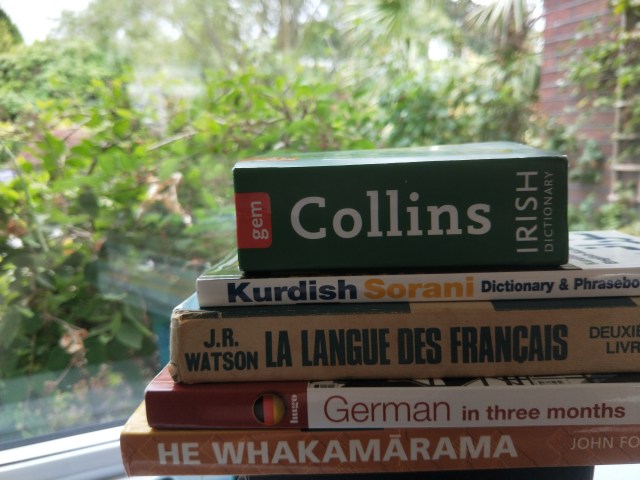
  • Like nearly all children in the Republic, I studied Irish – not Gaelic – for fourteen years, and a European language (in my case, French) for six years. And like most Irish children, I arrived into adulthood without fluency in either*. So 2007 and 2008 marked a time in my life when I tried to learn Irish in a self-motivated fashion.  This meant night classes at Conradh na Gaeilge, Irish literature, and a glorious hill walking trip with Oideas Gael. This is also the time that I started using my Irish name (I was born a Murray) and eventually changed it by deed poll.
  • The monolingual years – 2008-2012 – were spent in London. I suppose I learnt more about English.
  • In 2013/2014 I was the lucky nanny to an amazing Romanian family. It was my job to teach their son Daniel to speak English and, as a result of this immersion,  I also learnt how to understand a lot of toddler Romanian – all gone now.
  • In 2014/2015 I set my sights on German, for very practical and career-focused reasons. Indeed, I can imagine no other reason for learning German.  I took evening classes, and then I was in a bike crash, which stopped me going to evening classes. The dream cracked when my knee cap did (that sentence was harder for me than it was for you).
  • Early 2017 and it was time for Middle Kurdish. There are multiple Kurdish languages, you ask? Indeed. I can also tell you that Sorani Kurdish is not even the most prominent one, and I started learning it because I am prone to making excellent life choices.  German also resurfaced this year, as I was working in a refugee camp with a lot of Iraqi-Kurdish children and German volunteers.
  • 2017/2018 was my trip to New Zealand, and Te Reo Māori time.  I was tasked with writing trilingual theatre in Irish, Te Reo and English. Another very commercially viable life choice.  I learnt Te Reo from Makyla Curtis first, then from the amazing community leader, Warren Chase.  More on that later.
  • And now we find ourselves diving once more into French.  To explain the sudden interest in French is far too complicated… wait, no it isn’t. I lied about my speaking French in a job interview, then got the job, and had to improve real quick.

And here we are!

My current thinking…

I don’t learn languages compulsively because I am a neurotic nerd who likes to make her own dictionaries, though that is also very much the truth.  I learn languages situationally because I find myself in a multi-lingual place where I need them.

I sometimes need them because it is functional. You try running a creche without being able to say ‘biscuit’ or ‘home time’ or ‘STOP HITTING HAMA!’ to the little people. Or I learn them because it’s inevitable, as with my Romanian friends. Or because it is politically or artistically important, as I believe Kurdish, Irish and Te Reo Māori are.  They all have been, or are being, actively repressed.  I support Te Reo Māori because I support tino rangatiratanga and because my learning the language sends a message to the white Kiwi’s around me about whose land I believe we are standing on.

So if I am collecting these languages because they are useful, it makes sense that they change as my situation changes.  And if my goals are relative (I never attempted to read or write in Kurdish, for example, as I didn’t need to) then polyglotism becomes a lot easier.  And polyglotism is the goal.

I want to be a speaker of many languages and a master of none because polyglotism is an antidote to anxiety, an exercise in patience, humility, and a good sucker punch to the ego.  Polyglotism is these things because it is an impossible aspiration – a multi-level video game you cannot win. It is not possible to know even one language fully. Never in a human life. And so it is not possible to know two, three, four fully – and it is never, ever possible to know them all. As Nicki Minaj, my most frequently referenced academic source, would put it – second languages son you.

Learning a language makes you into a child again.  A lot of people find that mortifying.

I do not find it mortifying because I do not find childhood mortifying because I am no longer an asshole, if you remember.  I admire children and their immense linguistic capacity. I do not believe that this capacity dims irreparably over time, as others do.  I think our ability to respect childhood dims over time, I believe that our insistence in an adulthood that is impervious to core change increases, as does our adult fear of being wordless, therefore defenceless.  We believe in the cult of our own adult selves more as we age, and we become boring and lazy and crap at listening to other people, maybe because we suspect them of also being in a self-centred cult-of-one.

There is nothing that you lose by playing with language, or by learning more languages (I would die happy if I could convince white New Zealand of that fact).   You lose nothing.  Other than your ability to insist that YOU ARE, IN FACT, IN FULL CONTROL AND WEARING A TIE. Ironically, that insistence is a manifestation of the aspect of your personality that is the most petulant, and juvenile – the part of you that no one admires.

What you will receive from learning languages are, in no particular order –

  • A better ability to practically navigate the world as a traveller and citizen
  • A hugely enhanced ability to build relationships with people from other countries and cultures, who currently think you’re an arrogant twot
  • Access to the lore, music, ecology, philosophy, story, history, humour, and spirituality that are contained in a language
  • A better knowledge of what is on the menu before you accidentally order something containing dairy. I know you don’t like dairy – it bloats you.
  • If you care about little things like peace building, reconciliation and conflict resolution, linguistic diversity helps immeasurably with that.
  • Discovering beauty, as well as meaning.  We all accept that English is a more effective language for global commerce than Irish.  Could it not follow that Irish might be better at something else in its own right, too? I think anyone who has glimpsed the sheer breadth of native Irish vocabulary can attest that it captures things that are indefinable (or boring) in translation. Prove me wrong!
  • On that, languages make you funnier, in more ways and places, more often. Did you know it is an acceptable German insult to call someone a plug-socket inseminator?
  • Finally, foreign languages give you access to knew concepts that, quite simply, do not exist in English, and yet are observably true and real. Contemporary English compels us to specify a binary gender for the third person singular (he/she) in such a way that non-binary individuals struggle to know what to call themselves.  This struggle is not necessary, and doesn’t exist in many languages. If ever your Anglophone friend practically flips a table at the idea of ”’new”” gender-neutral pronouns, remind them that many, many languages have gotten on fine without gendered third person singulars, at all.  Neither Sorani Kurdish not Te Reo Māori use them, and those are just two languages that I’ve encountered personally.

I haven’t listed everything good that language learning does here (post-colonial healing, for example, is a whole other blog).

But I do know that Anglophones, of all the linguistic demographics, find the benefits of polyglotism hardest to grasp.

I beg you, English speakers of my acquaintance, let’s break that mould.

I’m looking for the French, German, Kurdish and Te Reo curious minds out there who want to try being less boring with me, and aspire to have good conversations with old timers in far flung corners of the world.

*MORE ABOUT THIS IN FUTURE BLOGS


What I’m Reading Now – The Story Of My Teeth, by Valeria Luiselli

Every so often I read a book so good that I want to snuggle it like a pet and recite it at ceremonies. A book that gives me solace, as it assures me that my writing never really mattered, anyway, because half the literary world could down tools tomorrow and this book would take care of business (also how I feel about Donald Glover in general). A book so good it makes me shift the imaginary seats around at the imaginary table I have set for the ‘Best Dinner Party Ever – Guests Living or Dead‘.

This is how Valeria Luiselli took seat seven at my imaginary dinner party, between David Bowie and my real-life bestie Ciara Ross (know where you’re from, show respect, stay humble).

I have read the first two of the eight stories that make up The Story Of My Teeth and already it is a stonker. It reminds me of Donna Tartt’s The Secret History, for no other reason than both of them make me think ‘This is close to perfect‘. A feeling which I first heard expressed by my Mum’s bestie, Trish Slattery, about Tartt’s novel, to give credit where it’s due (know where you’re from, etc…).

The Story Of My Teeth follows the exploits of Gustavo Sánchez Sánchez.  On the first page, he proclaims ‘This is the story of my teeth, and a treatise on collectibles and the variable value of objects‘. On the second page, he describes his birth as a hairy brown baby, already sporting four premature teeth – ‘But Mom took me in her arms the moment she saw me: a tiny, brown, swollen blob fish.  She had been trained to accept filth as her fate. Dad hadn’t.‘ On the third page, he describes his house, and his father’s armchair, which ‘Mom inherited from Mr. Cortázar, our neighbour in 4-A, after he died of tetanus. When Mr. Cortázar’s progeny came to take away his belongings, they left us his macaw, Criteria – who suffered a terminal case of sadness after a few weeks – and the green velvet armchair where Dad took to lounging every evening.

I could go on. Every short page contains sentences that bring me pure joy. The writing is sparse, it moves quickly by saying exactly what it needs to.

The Story Of My Teeth is funny in my favourite way, and the hardest way.  It does not rely on one liners, but a dark atmospheric humour, a cumulative humour, it builds up slowly, from lines that are wry, or awful, or so smart and satisfying that they produce humour-like-symptoms – you find yourself laughing for no reason. Perhaps because you are delighted to be as wicked as the book is.

I’m trying to stick to the 500 word limit in this blog (I’ve broken it a few times) so I’ll just remind you that this book was written by Mexican/South African author Valeria Luiselli IN COLLABORATION WITH WORKERS AT A JUICE FACTORY.

A JUICE FACTORY.

I am dead.

Read if – You like reading.

Avoid if – You’re a dope.

Up next! – Just wanted to give a shout out to Annemarie Ní Churreáin for snail-mailing me a copy of Emilie Pine’s wonderful book, Notes To Self.  What a deadly gift! Annemarie is a style icon of mine (though I am a sewer rat and do not dress or write like her) because she is amazing and sophisticated and cool and wise, so wise! And she does things like this for the love of good books! Good on you, Annemarie, and thank you.


My Friends Are Cooler Than You Friends (I’m Sorry To Break The News So Bluntly, But Someone Had To Say It)

I studied at London’s Central School of Speech and Drama, which my phone just tried to autocorrect to read ‘Central School of Speech and Dreams’ which it sort of isn’t but is trying to be. (FYI I refuse to add the Royal to it’s name, unless the title was granted by Europe’s only legitimate queen, Panti Bliss)

During my fantastic, strange and confusing time there as a far-too-young-and-inexperienced Performance Arts student, I met and lived with some truly extraordinary people. One of them, the beautiful design student, Ben Giddins, got married two weekends ago to the brilliant Queer Theorist and Bow-Tied Writer, Joe Parslow.

Aside from being an acclaimed drag queen and writer, respectively, and club owners / queer community leaders, together, these excellent minds are the inspiration of my first play, Aunty Ben.

I’m often asked what inspired me to write that play. I lived with Ben in my second year of college, and I remember the day I found out he was going to be an uncle. After that I got to observe, and still have the privilege of observing, how amazing Ben and Joe were and are as uncles, specifically, and as role models for young people, generally. They combine many traits that are FUNDAMENTAL to happy childhoods and empathic adulthoods. They are loving, giving, active and dedicated family members for the right-now, and they are exciting examples of what a person can become for-the-future, gender-bending beacons of hope and resilience.

It was Gracie, Ben’s niece, who first started calling him Aunty as well as Uncle, unprompted, because it seemed to make sense to her. Blessed with excellent parents and grandparents (and now a gorgeous little brother!) and two of the kindest, queerest uncles in the world means that Gracie has had the sort of childhood that most of us can only dream of – one of limitless love and limitless possibilities, so many examples of ways of being that co-exist in her immediate family instead of competing with each other. I imagine (I hope) that there is very little you could convince Gracie that she couldn’t become in the future because she knows whatever social rules exist are made to be disregarded, and that creativity, wit, charm and a huge dose of love bring huge rewards to a person and a family.

Anyway – here’s to Ben and Joe! To many more years of Camden Power Coupledom and Excellent Fashion, Laughs, Love, and – what I would wish anyone on their wedding day – loadsa riding and loadsa love.

X

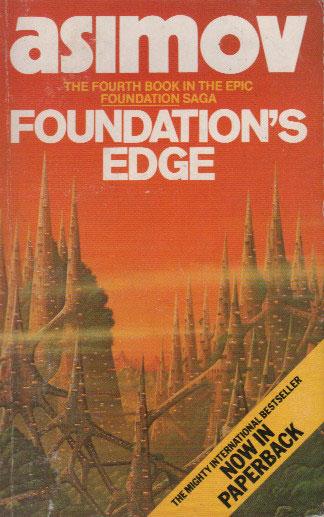
What I’m Reading Now – Foundation’s Edge, by Isaac Asimov

In a previous blog, I levelled a few charges against old school sci-fi. Namely, that it can be humorless, long-winded, dry as a rice cracker,  krhynjee (that’s ‘cringey’ spelt in the language of the Beefliklijek sector), varying degrees of sexist and racist. I believe I said it ‘does not date well‘ – I was feeling benevolent, that day.

Unfortunately, the Foundation series has all of the above flaws, to some degree. For those who are faint of heart… cringe, and depart…

It’s not funny. Not even once, and not even by accident. A statistical improbability, yet so it is. It is dry, a touch long winded – not as much as I imagined, though. Neither does it have too many moments of racism (it does have a ‘noble savage’ dynamic going on). As with many books by Great Whites, however, it didn’t even give itself the chance. The amount of racism in a book usually depends on the amount of people of colour described by the white author a.k.a. there were none, so there were none.

The book is at its worst when describing women. Many passages promise to be an uncomfortable read for anyone who isn’t an actual toddler, Norman Mailer, or perhaps a sex offender. At one point, our protagonist Trevize  – a politician who has been illegally exiled from his home planet indefinitely, without losing his cool – flips his lid because he is greeted by a female character at a space station (‘They sent a girl!‘ he exclaims, more than once. The girl is hot, twenty-three-ish, and wearing transparent clothes. Her name is Bliss).

There is no point describing Asimov describing women further, really. If you are surprised to hear that some famous authors dislike women, or perhaps simply do not know a way to write female characters without seeming to dislike women, I don’t know what you’re doing suddenly reading books, having apparently never read one before in your life.

HOWEVER. AND AT THE END OF THE GALACTIC STANDARD DAY….

I love a bit o’ Foundation.

I love it because and I like things that perform conceptual gymnastics. I like the strange dressage of possibility presented in sci-fi, so much that I don’t mind it being a touch preposterous. Sometimes ludicrous.  There were moments of Foundation’s Edge where I wondered if the intriguing political and social question posed at the start of the series had lost the plot and devolved into silliness.  Then I realised I didn’t care.

That intriguing political and social question, if you’re interested, seems to me to be – what constitutes the divine right to govern a whole Galaxy (a.k.a. IS THE FOUNDATION REALLY JUST AN ORANGE LODGE?).  The Foundation Series is a story that follows the agents of a ‘paternalistic’ autocracy of sorts, and I suppose the series explores whether autocracy can be kind and benevolent, at all.  If not, it makes one wonder whether the concentration of power in the hands of a few is avoidable, and if it isn’t, whether a more paternalistic autocracy, relatively to others, has it’s place.  Foundation also asks us to think about just how predictable human behaviour is en masse.  (Google the term Youth Bulge – citizen’s revolts, at least, can be seen as a type of set dance, repeating.)  If the powers-that-be could predict our behaviour, even our ignorant, crappy, Brexit-type behaviour, would we be better or worse off if they just left us to it? What about if they decided we needed guidance – what if that guidance lasted for millennia, in order to deliver us from evil?

Like I said, sometimes I found Foundation’s Edge straying from the above content, from what I find to be it’s central intrigue.  Still, I don’t care as much as I should, because what’s left is space travel and espionage and ‘mentalics’ and a villain called ‘The Mule’ and loads of secret societies. I will be reading the next book regardless.

High points were the depiction of Mayor Branno, seemingly the first competent, respected female in the Galaxy since Bayta Daryll (Foundation and Empire), and the many presentations of the myths surrounding the mythical home-planet of ‘Earth’.  Also, the Sayshellian food sounded delicious, and I want some.

Good quote – And as he and the computer held hands, their thinking merged and it no longer mattered whether his eyes were open or closed. Opening them did not improve his vision nor did closing them dim it.

Read if – You are interested in myth-making in a far distant future.

Avoid if – You are offended by lazy stereotypes. Or lazy prose.

Strangest sexist extract – (Bliss – the woman in the see-through dress, has just arrived.  She has been asked if she is human by Pelorat, who must be in his fifties, and replies ‘Do I look human?’)

Pelorat nodded and said with a small smile ‘I can’t deny it. Quite human. Delightfully human.’

The young woman spread her arms as though inviting closer examination. ‘I should hope so. Men have died for this body.’

‘I would rather live for it,’ said Pelorat, finding a vein of gallantry that faintly surprised him.

‘Good choice,’ said the woman solemnly. ‘Once this body is attained, all sighs become sighs of ecstacy.’

(Then, only a few pages later, after the description ‘just a girl’ has been used at least four times to describe Bliss… Trevize makes a dig at her figure…)

‘Men have died for this body. Huh – she’s bottom-heavy!’

A Defence of Asimov and Clarke….

IMG20180731015117

I’m not a huge science fiction nut. But after I discovered a second hand bookshop near to my dentist that has a bewildering amount of old pulp novels, I started picking up a few. It’s obvious that the books I’m picking up come into the shop from one specific donor because, even for sci-fi novels, the selection is very specific. A lot of forties, fifties and sixties sci-fi, a lot of Pan Publishing books, and a lot of Asimov and Clarke.

Just to put my own lack-of expertise on the table, these are the books I’ve read within the two-to-three years that I’ve been taking good care of my teeth…

  • First, Arthur C. Clarke’s The Fountains of Paradise
  • Then Issac Asimov’s The God’s Themselves (perhaps my favourite so far)
  • Clarke’s Childhood’s End which I don’t think I finished
  • Issac Asimov’s Foundation, then Foundation and Empire, and then Second Foundation
  • Unable to access my dentist-adjacent shop while in New Zealand, I read Jules Verne’s Journey to the Centre of the Earth and 20,000 Leagues Under The Sea.
  • Now I’m back on the fourth Foundation novel – Foundation’s Edge.

So I’m about to write about the last book on the list, but it seems I have a quick thing I wanted to say about the above books first, a word of warning and of encouragement for the Asimovice (a pun that I will most likely delete later).

First off, science fiction can be a hard sell for many, because it gives a very uncharismatic first impression. Just like the ignoble Ewok, it can seem fundamentally childish, and relatively irrelevant. Then again, irrelevant isn’t so bad, you might think – loads of media we consume is flim-flamish, meaningless guff that, nevertheless, entertains. Who cares about relevance if we’re having fun?

But then you remember that sci-fi classics are steadfastly humourless, and so fun isn’t always possible. Asimov and Clarke (though not our lovely friend Verne) are dry, my children, as dry, dry, dry as a sex-talk from a Christian Brother. Furthermore, they’re guaranteed to make a modern reader uncomfortable at some point (to say that they don’t always ‘date well’, politically, is a kindness). They can be scientifically confusing at times, perhaps to fudge the laws of physics in service of new frontiers of plausibility.

Or maybe some of us simply cringe at the idea of reading a book about imaginary politics on the wooded but sulphurous moon of Xilyion, whose protagonist is (in descending order of importance) a space-pilot, a bore at dinner parties, and blue.

The thing is, though, that sci-fi, however dated, remains one of the most compelling genres I can think of through which to explore human crisis, on a collective, sometimes global level. It is a philosophic genre, and it has made me think deeply about huge and pertinent problems that are sometimes timeless, sometimes current, and occasionally even a step ahead of genuine scientific thought (check out how HG Wells jumped the gun on time travel). Sci-fi exposes scientific progress to catalytic exchanges with the best and worst of human tendency, and as a result it can occasionally strike philosophical truths that turn out to be sociologically accurate. The best example right now is how the TV series Black Mirror has awkwardly mirrored real-life political developments in the UK and China.

As much as I cannot get the literary treatment of ”negro” characters out of my head from Childhoods End (perhaps I stopped reading it for that reason, I can’t remember) I also cannot get the questions these books pose from my head, either. I’ve read thousands of books in my life, but I remember reading Ender’s Game when I was fifteen with real clarity. I remember (not quite sci-fi, and in no way dry) The MaddAddam Trilogy by Atwood as one of the best reader experiences of my adult years. Oryx & Crake is another book, by the way, that accurately predicts several things, including a US/Mexican wall.

So, even if you’re afraid of Josh dunking your head in a toilet for being a nerd, try sci-fi if you want to see the newest global dilemmas rub up against old ones, or explore how humans enact utopia and dystopia out of the same raw materials of scientific discover.

It’s the ancient interplay of the sacred and profane made new.

Can’t wait for my next filling.

S x

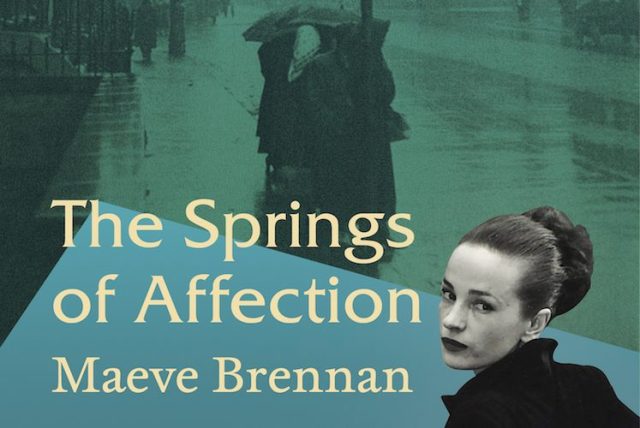
What I’m Reading Now – The Springs of Affection, Maeve Brennan

The Springs of Affection came to me through the amazing Ciara Fitzpatrick, one of the few true readers of my hyper-active general acquaintance. My main man Borges said he was ‘more proud of the books I have read than those I have written‘ and I’d admit to being more impressed by a great reader than a great writer (the former being rarer and more valuable). So Ciara’s recommendations have some weight. On the book’s inside jacket, she wrote ‘As you depart on your Antipodean adventures – may Maeve bring you back home when you need it.‘ As it turned out, all I brought to New Zealand was a backpack and set of bicycle paniers. I didn’t have room for Maeve, so promised to read her on my return, which I duly did. And what a wonder she is. And even in Dublin, she brought me home, or showed me home, or something.

We could all go blue in the face wondering how writers rise, or fail to rise, and why. All sorts of things can knock the air out of the soufflé of a writer’s legacy, being a woman at most times in recent history meant you were left totally out of the oven. Maeve, however, was a known literary figure in New York, a columnist, her collections favourably reviewed. Still, it all just doesn’t sit right. Dublin, after all, names and celebrates it’s chroniclers. Dublin knows about her Martello Towers and her borstal boys and just how Irish Beckett considered himself, all left and gone in Paris. We know. We like to know. We should know more about Maeve. We have been missing something all this time.

Despite the fact that Maeve wrote from New York, the world of her work is Irish in a way that is breathtaking and not-at-all breathtaking, that is totally un-diaspora in it’s reflections of home. It is crisp – it surprises me how much of the Dublin described in her book, I have never seen, having disappeared before my birth, and still how it seems close. The tram system referenced in the book is one that closed in 1949. When I returned from New Zealand this summer, I came back to an O’Connell street with a new tram system, the first time in fifty-eight years my commute might intersect with Mrs Derdons. But it seems we are closer in age than that.

This is a voice of a writer you wish was still living, not because she left a legacy of work unfinished, but because you’d want to know how a woman who could write like this shot the shit over a cocktail.

Read if – You like your wit dry, your protagonists slightly pathetic, and your old-timey Irish literature unnostalgic, and if you want less misery and abuse than the usual Irish serving.

Avoid if – the idea of a house bound woman’s life or a child’s perspective is of no existential interest to you (which begs the question, what are you doing on this blog?)

Nouveau-Reviewer Faux Pas … What I’m Reading Now

There’s a whole bunch of stuff I do that I don’t broadcast online. Partially because my daily routine is grotesquely boring (I spend a surprising amount of time conjugating verbs) and in other cases because I believe certain types of content should never be blogged about in the first place. For example, if I wanted to know about what you had for dinner, I would be reading about it in the Guardian because your name would be Jay Rayner.  If not, eat in digital obscurity. There. Someone needed to say it.

However, one of the things I do a lot of is reading, which I think has some relevance here. As does going to arts events and otherwise hanging around Ireland and New Zealand’s creative whānau. As does (conjugations aside) my quest to learn two languages simultaneously, perfect another one on top of that, and use the four of them in my daily life. I call it the Polyglot Project and it might make an interesting chronicle for those interested in doomed enterprises and the folly of an Irish-Te Reo Māori dictionary (the book that every home has been waiting for?)

So I’m going to start posting about what I’m reading, weekly. They are not strictly reviews, because down that rabbit hole lies an anxious questioning of my own literary judgement, and other readers’ judgements of my judgements.  What you can expect of my non-reviews are a lot of spirited reactions, unjustified statements, and flowery affection, and a complete avoidance of nouveau-reviewer faux-pas. On this page you will find no –

  1. Stars and Ratings – more reductive than instructive for the reader.
  2. Comparison to other authors – I magpie my books from a very wide range of sources, which means I don’t know half of what you mean when you tell me Beckett is to Ionesco as cream-cheese is to sorrow. If I’m reading Lolita, it’s likely because I found a copy of Lolita in a bin on Tuesday. If Spot The Dog is found in the same bin as I pass it on Thursday, then I shall duly read that, too. I’d like to say I don’t compare writers to other writers because it seems alienating to the non-literatti (which it is) but mainly it’s because I’m not well read enough to use the language of the literatti. Probably because I spend my time rummaging through refuse.
  3. Lambasting of literature – My sensible-self maintains that the phrase ‘that wouldn’t be me, now‘ is far more useful a perspective than ‘the absolute hack of that book‘.   I’m training myself to see what’s not-for-me in a book, as opposed to what’s ‘bad’.  It was a tough lessen I learnt at the hand of The Truth About The Harry Quebert Affair.  After all, it’s wildly popular, has won multiple awards and has been translated into 32 languages. It is, by all accounts, “a good book”. Who am I to call it a putrid offensively-lazy colostomy bag of cliché? Who am I to judge?
  4. Correct Spelling. I do not have a pocket sized copy editor.
  5. Posts over 500 words.

How word-counts fly.

I hope you enjoy them, anyway!

S x

My Friends Are Cooler Than Your Friends (according to them, not me – that would be rude, I’d never say that to your face) Part 1

Being a homeless bougie backpacker has it’s perks – one of which is meeting cool people, and getting to spend artist residency time getting to know amazing international makers.

Two Adelaide natives staying in New Zealand Pacific Studios in February are Danny Jarratt (queer artist extraordinaire) and Alex Beckinsale (the best dressed lady at the tea party), and not only is their work incredible, but so is their company.

We had an open studio on Saturday, but in way, way, way more important news we built a fort in NZPS on Sunday and watched vampire anime movies and ate Jalapeño popcorn. I’m gonna get documentation of both of those crucial life-events, but in the meantime, you should check out their work in the links above and the pictures below.

S x